In October 2022, Dr. Tawandra Rowell-Cunsolo was selected to participate in the Interdisciplinary Research Leaderships program with the Robert Wood Johnson Foundation. Designed for teams of two researchers and one community leader, Interdisciplinary Research Leaders support teams as they work with their communities to design and conduct rigorous research to explore critical issues, then apply the findings in real time to advance health and equity. As a member of the 2020-2023 cohort, Dr. Rowell-Cunsolo collaborated with researchers at SUNY-Old Westbury and the Brooklyn Movement Center in Brooklyn, New York. They examined the impact of both direct and indirect exposure to the criminal legal system on the health of Black Central Brooklyn residents.
The purpose of this study was to examine the extent of direct and indirect CLS exposure, and to identify associations between exposures to the CLS and health among Black residents in Central Brooklyn, one of the largest concentrations of Black people in the United States.
This study values the lived experiences of community members, as they are crucial to building power and capacity to inform more equitable policies. This perspective is deeply influenced by the Brooklyn Movement Center’s (BMC) community-based wisdom and principles.
Data for this study were drawn from a larger community-based study on public safety conducted in collaboration with Communities United for Police Reform (CPR), which is comprised of several NYC-based organizations, including the Brooklyn Movement Center. In November 2021, surveys were administered to 207 Central Brooklyn residents. The survey collected socio-demographic information and asked respondents to report direct and indirect exposure to the legal system. This included instances of incarceration, police violence, several categories of police-initiated interactions, feelings of concern about contact with the police, and other interactions. Participants were also asked to rate their own physical and mental health.
Our data analysis focused on the 149 (72%) respondents who identified as Black. The majority of respondents had been directly or indirectly exposed to the CLS. Generally, respondents were more likely to self-report better mental and physical health if they had no history of either direct or indirect exposure to incarceration. Similarly, respondents who had been exposed to incarceration were twice as likely to report a PHQ-2 score of three or higher compared to those with no exposure.
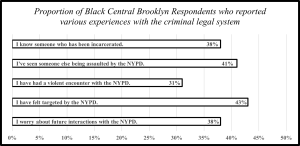
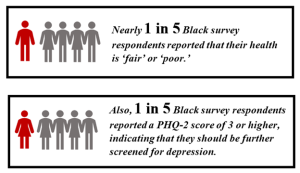
Current public safety measures have resulted in high levels of exposure to the CLS among Black Central Brooklyn residents. Previous studies have documented a range of negative health outcomes associated with these exposures1-3. Increasing awareness of police violence and CLS engagement is a crucial step toward advocating for more just and equitable public safety strategies.
Alternatives to public safety strategies that disproportionately target Black Americans are also desperately needed. The results of this study help raise awareness of the reach and health impacts of the CLS and equip Black Central Brooklyn residents with information for local organizing and advocacy efforts.
REFERENCES
-
Hinton, E. et al. (2018). Unjust burden: The disparate treatment of Black Americans in the criminal justice system. Vera Institute of Justice: New York, NY.
-
Sundaresh, R. et al. (2020). Exposure to the US Criminal Legal System and Well-Being: A 2018 Cross-Sectional Study. AJPH, 110, S116–S122.
-
Haile, R., et al. (2023). A systematic review and synthesis of the direct and indirect health consequences of police violence. Soc Sci & Me